Showing posts with label gardening. Show all posts

Monday, July 15, 2024

Tips for Growing Peas


There's almost nothing more delicious than eating peas for dinner while they were still growing a few hours prior to dinner. Growing peas is pretty easy overall and they can be grown in fairly poor soil if need be.
Peas can be pretty close together. I usually plant two rows per trellis. I put the peas in the ground just a couple inches from one another and I leave no more than 4 inches between the rows. It is said that peas can be planted as soon as the ground can be worked. In my experience, it is better to wait. I'm in a cold area and it's true that pea plants are very hardy, but I've noticed that if I start later the germination is quicker and seems better all around. I usually start between mid-April and the beginning of May.
Just like most of my other vegetables, I grow peas in hills. Especially with the climate change, we are having more torrential downpours than we used to have, and the hills prevent the peas from being flooded or being in standing water.
I put the trellis up immediately after I put the peas in the ground. No need to wait until the plants are big and fall over. By the time the plants are big I am far too busy in the garden with other things, I don't have time to put a trellis up, so I do it right away.
The trellis consists of just a few stakes with chicken wire. Peas don't require a very strong trellis.
The height of the trellis depends on the kind of peas. I've seen the plants grow 7 feet tall, and I've seen them as low as 2 feet. I prefer the lower ones as they can stand more wind without pushing the trellis down.

Here is a picture mid-season.

The peas are ready to be harvested once they feel hard and full. Don't be tempted to pick them when they are not completely full. They won't be ready. But here we have to keep in mind that peas won't wait until we're ready to pick them. When they are ready they need to be picked or they'll look and taste old. I am referring to peas that need to be shelled as I rarely grow the sugar snaps. The pods always seem stringy.
Shelling peas is not a quick job, it takes time. I'm easily shelling a half hour to get enough peas done for a meal for two but it's so worth it.


Wednesday, July 3, 2024

Using Cardboard as Weed Barrier


The picture above shows what my corn patch looks like at the moment.
This year is my first experience with using cardboard as weed barrier. Here I thought that I was the first one to come up with this idea but after doing some research it turns out that this is not an unusual thing to do. So far it seems to be working out well. Since this is new to me, I did do a lot of reading up on it to make sure I'd know what I was getting myself into. 

Here are a few hints:
- Only use brown cardboard without any text because text = ink and you don't want that in the garden. Best is to find large pieces of cardboard. I was lucky to find quite a few of those.
- Absolutely do not use any cardboard with glue. If you look at a cardboard box, you will see that it is glued in one corner. I have cut this out of all the boxes that I used. Cardboard is often double layered with glue in-between but apparently that kind of glue is something natural and thus harmless.
- Remove all tape because that too is glue. I even went as far as to cut out the pieces of cardboard that had tape. I don't think it's necessary. Removing the tape should be sufficient.

Putting the cardboard down.
This is easy as pie. I used a simple steak knife to cut the cardboard. I found that a serrated knife works the best. I measured the distance between my rows and cut the cardboard accordingly. I made sure that the pieces overlap. It's very strongly suggested to weed before putting the cardboard down.
Also, I didn't read about this but found out the hard way: put the cardboard down when the ground is dry. I noticed that in some places where the ground was wet, the water stays on the cardboard after it rains. This is not happening in places where I put the cardboard on dry soil.

The use of mulch.
I read on several sites that you should put mulch on top of the cardboard in order to keep it in place. I don't want to bother with mulch and so far, all my cardboard has stayed in place on its own. I've also read that some people use stones to keep the cardboard down. Since I use very long pieces of cardboard, I don't think it's necessary to do so. I'd say use your judgement. I've had no problems at all with the wind blowing the cardboard around, it has not happened so far.
In some places where I used smaller pieces of cardboard, I covered it with hay and grass clippings.

To decompose or not.
My neighbor tried using cardboard as weed barrier once, but he had to drag it all out of his garden after a few months because it was not decomposing. He did put it down in autumn and dragged it out in springtime. I put mine down in springtime and hope it will be decomposed by next spring.
I noticed that in the spots where I put hay and grass clippings on top of the cardboard, it decomposes faster.  Overall, I think that using cardboard as weed barrier is worth it. I'll update this post next spring as I should know by then whether the cardboard fully decomposed or not.
A major advantage of using cardboard as weed barrier is that the cardboard will feed the soil after decomposing. Only a little though. It isn't horse manure :)


Saturday, June 22, 2024

Growing Giant Peruvian Corn

 We grew giant Peruvian corn for 5 years in a row until this past growing season we decided to stop growing it.
Keep reading to find out about the great, the good, the bad, and the ugly about growing giant Peruvian corn.

The giant Peruvian corn stalk easily grow up to 20 to 24 feet which is 6.09 to 7.31 meters. They grow super quickly too. The stalks become so thick they almost look like small trees and the good thing is that the stalks can be used the next season to make trellises for beans and whatnot as long as they are kept in a dry spot in wintertime.

Here are some pictures of the corn:


Impressive for sure. Visitors loved it and we always got a lot of oohs and aahs but you know what we didn't get? Corn! That's right, we never had any corn to speak of except last year, but it wasn't pretty. The ears would grow big and thick. They too were impressive, but something always went wrong. Critters and birds got away with them and they didn't want to share with us, or the season wasn't long enough for the ears to mature, you name it, it happened. 


The corn would sometimes fall over in a storm. Due to the huge stalks, they caught a good amount of wind. A decent storm would knock them over.
This past year I had started the corn inside the greenhouse. As they say, by the 4th of July the corn should be knee high. Mine was well above my head by the 4th of July. So here we thought we would eat some giant Peruvian corn at last, and we did. It was tough, bland, and chewy, we had left it on the stalks for too long but who knew. These ears took longer to mature than regular corn, and we were inexperienced. This is when we decided to stop growing this kind of corn. For stalks to get this tall, it takes a lot of nutrients out of the soil.
I miss seeing those giants but it's for the better.


Tuesday, June 18, 2024

Strawberry secrets

 Well, this was my first experience with growing strawberries.

I purchased 10 small strawberry plants last year. Great was my excitement when I found a handful of strawberries on the plants. I saved the runners and planted them in little pots in September. Runners are vine-like extensions that shoot out of the plants and grow some leaves as well as some roots.

Once the runners were well established in the pots, it was time to plant them outdoors.

I made a hill of about a foot tall and planted the runners about 12 to 15 inches apart. Once planted, I covered the entire hill with hay, and this has definitely kept the weeds down.

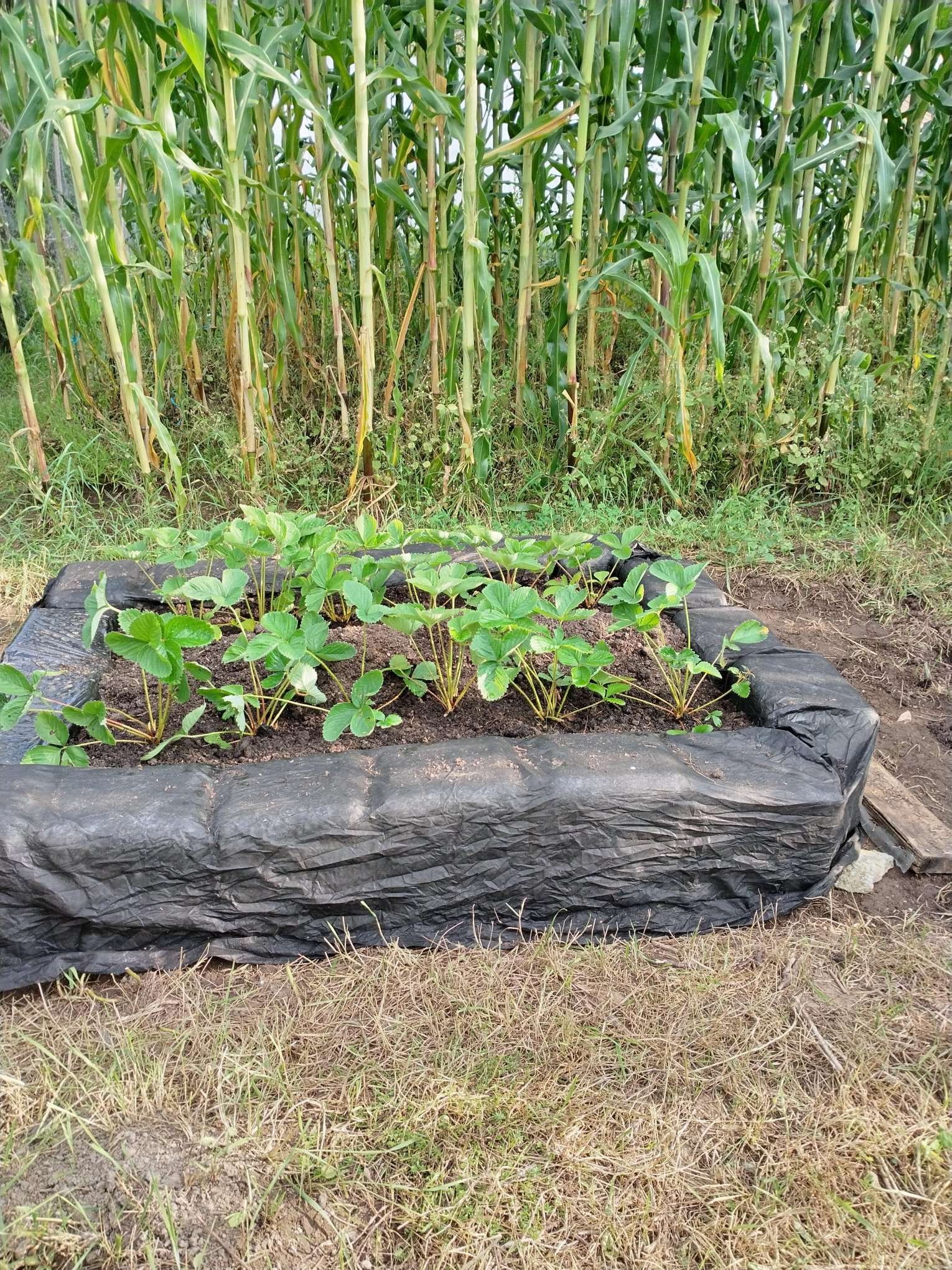
I also planted some runners inside a stack of two tires plus I made a raised bed out of Styrofoam boxes. At that point, the runners had gotten pretty big.

This is what it looked like:


After my strawberry beds had been set up, fall and winter came and the gardens took a long, cold nap. Would the strawberry plants survive the bitter cold? Would the snow flatten them?
Once spring came and the snow melted away, I was happy to see the strawberry plants come to life.
Fast-forward a few months, and June has been beyond generous. With still numerous strawberries to pick, I have already frozen 10 quarts.


The strawberries are big and oh so sweet.


Four quarts in the sink, just from today's harvest.


I didn't even use half of the runners. I am convinced that you can start a strawberry farm with just 10 plants. If I saved all the runners from this year, I'd literally have hundreds of plants.


Saturday, October 14, 2017

Adirondack living

Life is about simplicity. It's about rolling snowballs, conquering mountains, and smelling freshly picked walnuts. 

Once upon a time, a friend far away, published a comic strip. One page showed a man, sitting at a table on his patio with a multi-million dollar home behind him and a swimming pool large enough to shoot another Jaws movie at. The man was writing about how he felt that his whole life had been a failure.

I am sitting at my hand-me-down desk when I write this. The puddle in my driveway is the only swimming pool I'll ever own. Happy? You bet! I'm just minutes away from the most beautiful views in the world. The cat is purring in her sleep, the chickens produced 6 eggs today, and we ate our own, organic red beets for dinner. They were still growing in the garden two hours ago. It doesn't get any better than this.

This blog is about living in the Adirondacks region just outside of the Adirondack Park. It is about living where many people would not want to live. It's too far out in the boonies, it's too cold in winter, there are too many wild animals lurking in the bushes, it's too far to get to the grocery store, etc... There are many times when I wish I could live somewhere else. However, it's close to the mountains, the deer are practically within petting distance, and who needs to go grocery shopping when the freezer is full with home grown organic vegetables?

Welcome to this journey. Glad you stopped in.

Picture taken from the summit of Ampersand Mountain.